Showing posts with label humanity. Show all posts

Wednesday, December 03, 2014

On Offense

K. says...

"So what is your take on "cultural appropriation"? Seems to be a hot topic on tumblr and instagram. Got to an argument about this on the last one."

The primary irony here is that this conversation about cultural appropriation is being had by white Europeans.  The secondary irony is that worries about cultural appropriation are being dismissed by people from a nation whose self-identity, self-worth, and history is almost entirely about its distinct culture.


The danger with cultural appropriation is that it dilutes cultural identity, which can be extremely important. (E.g. you know how American black people often have ridiculous-sounding names? This is an extreme backlash against the destruction of their distinct identity after forced integration into the white American cultural space. Similarly, Hong Kong Chinese are very protective of their mix of Anglo and Chinese names, as this gives them a cultural identity that is distinct from the Mainland.) This is very difficult to internalize for people who are generally part of a dominant, unthreatened culture.

The difficulty with explaining this to Estonians is that at this point, they are so starved for worldwide attention that cultural appropriation would not be seen as a necessarily bad thing - the first example I thought of was a Kanye West remix of Tõnis Mägi's "Koit", but I expect most people would go "that's awesome!". Let's try to think of something more impactful: imagine yourself in a conversation with a Soviet Union apologist who is disparaging the low level of specifically Estonian culture, with its dumb and useless music like Tanel Padar; whereas in the olden days, Estonians had access to the works of superior Soviet artists like Georg Ots.

TL;DR: Be aware that even if something doesn't seem like a big deal to you, it might still be a big deal to someone else; not everyone's experiences mirror your own.

That I get and agree with. Someone talking bad about a particular culture or insulting it. But at the same time, items in itself don't have any meaning. People give them context which is important, especially for me in this case. This was a really beautiful photo of a female caucasian wearing a feathered native american headpiece to advertise it. The company selling them gets these pieces from native americans who actually make them. For me it was kinda the wrong place to feel offended. There was nothing insulting there (unless you blame the model for being born white since some other white people now and many in the past were doing bad things). Especially if you think on those cheap Halloween native american costumes and all of the 'acting stereotypical' ways. For me the interesting thing was that the main vocalists in this case were white teenage caucasians from Europe. There were quite a few fully or partially native americans who loved the photo.
If someone who is a supporter of the Soviet Union and its actions is insulting Estonian cultures or traditions, I could care less since I will certainly not be able to change his mind. Getting offended would just be a winning situation for the one doing the insulting. Maybe if they burned something on a political note? But in this case, if someone is doing it in supportive and positive way, why feel offended? But... as an article I once linked sad... offendedness depends mostly on the person who feels offended.

Okay, several points:

In the situation you described, the most relevant aspect is that this is probably being *sold* to white people. And if it's being sold to white people in America, then yes, I can see how that would be seen as a terrible thing to do - marginalizing a culture that has already been severely damaged by your own. Instead of providing life opportunities and developmental aid to Native American communities, the buyers are behaving like tourists - looking and pointing at the noble savages, throwing them a few coins and bringing back souvenirs to show their friends at home. This is not necessarily the attitude of the buyers, but it could certainly be construed that way by the Native Americans. 

Neither you nor I get to decide what Native Americans should or should not be offended by. And this extend to other situations. You don't get to tell me I shouldn't be offended at an antisemitic joke. I don't get to tell you that you shouldn't be offended at a sexist joke. As long as I realize that there is actually some reasonable historic/cultural background to explain why someone of another culture/minority *might* be offended, then I am going to be extremely weary of setting limits on their behalf regarding what is and isn't offensive. (We can have a fascinating conversation about why one joke about Jews is antisemitic and another one isn't, if you're patient.)

Now, there's certainly a good argument to be had against meta-offense; offense on behalf of another minority. But...

The situation you described - I can understand why this would horrify Europeans. Again, Estonia is sort of unique here because the community and culture has existed on this piece of land ever since there's been human habitation, and has pretty much never been in an expansionary war (but I tell you what, the people at the tourist office in Sigtuna were *genuinely* upset at me when I asked them where was the site of the former great church that the Estonian raiders burned down). So Estonians have never had to apologize, as a nation, for being extremely nasty to another nation. Almost every Western European nation has had to do that - I think the Irish are the only exception? Whereas white Americans most certainly have something to apologize for - several times over - but are, as a stereotype, militantly refusing to admit that they've done anything wrong, or at least that they are supposed to feel bad about something that their grandparents did.

So I can certainly understand the sequence of thought that leads Europeans to be embarrassed on behalf of the Caucasian race at the behavior of white Americans.


(Side note: as a member of the linguistics student minority, I am deeply and personally offended at your use of "I could care less" in that form. :P)

As for not being able to change someone's mind: that is not necessarily true. It's *difficult*, but it does happen occasionally, and when it does, it's worth the effort. Mostly it happens with the help of a strong external trigger, but that trigger needs to land on a fertile soil of awareness that there are other ways of thinking out there, and that apparently rational people subscribe to them. The long-form treatment of this is the film "American History X" with Edward Norton, which I recommend highly. The short-form is the old quote, I think attributed to Margaret Thatcher... Anyone who is not a socialist when they are young have no soul, and anyone who is not a capitalist when they are old have no brain. 

Monday, October 27, 2014

Paalalinna

So, there was a school shooting in Estonia today. A 15-year-old kid from a small town shot a 56-year-old lady teacher of German with a revolver. The teacher died. School staff took away the kid's gun; the police have him in custody.

His name and Facebook account leaked already, of course. No, I won't link it. He looks like a regular kid. Some of the stuff on his FB is disturbing in hindsight, but not more so than any 15-year-old boy's.

This is a terrible tragedy, but let's remember that outside of the context of what we've heard from America (and Finland, and Norway, and Canada), a disturbed 15-year-old getting hold of a gun and shooting a teacher is no more or less of a tragedy than a drunk 15-year-old getting hold of a car and running over a pedestrian.

What we need to do right now is to make the right conclusions from this. What society needs to do is to not completely freak out.

Thursday, July 11, 2013

MPDG Postmortem

I came across this excellent article by chance the other day. I have never heard of the author before, but I understand from friends' comments that she is fairly prominent; in any case, the article does a very good job of elaborating on a matter which, to me, is intuitively incontrovertible, but has been difficult to enunciate:

Men grow up expecting to be the hero of their own story. Women grow up expecting to be the supporting actress in somebody else's. 

In reading this response, you may at times feel the desire to suggest that I check my privilege or call the waaaambulance, and remind me that women have it a lot worse than men. I am not going to argue with you about that, primarily because you are correct. This is in no way intended to be a rebuttal of Laurie Penny's analysis. Being in possession of a penis, my ability to expound on matters of feminism is in any case very limited. However, what I can do is relate a tangential matter which I do feel I have the moral right to declare, as it is based on my personal history, both extended and recent. I would beg your patience in the realization that the perspective I am describing is a thing that exists (and is not limited to me alone). Indulge me in the acknowledgment of its validity.

Besides; this is my personal blog. This is where the waaambulance dumps is psychohazardous biowaste.

Thursday, October 04, 2012

Translators, especially ones like me (specializing on expensive rush jobs), rarely get to feel like their actions are directly making the world a better place.

Last night, just before midnight, I'm finishing up a video game and thinking I might as well go to sleep, when an email comes in. It's a translation agency I've not worked with before; a family has a sick child, and the local doctors can't make him better. They need a rush translation of the medical history. I'm not a dedicated medical translator (and that field has lots of specialist terminology, of course), but yes, I can get it done quickly. Two hours and seven pages later, I go to sleep.

This morning, I get a response from the agency. My translations were sent to hospitals in Germany late in the night, where the local doctors reviewed them and agreed to take on the case. I think the kid's on a plane right now or something.

I don't mind the usual work I do, but every once in a while, it's great to feel like I'm making a real difference in someone's life. Sure beats corporate correspondence, tax records, or user manuals for scooters.

Hope the kid will be alright.

Friday, July 13, 2012

And now for something different.

I'm going on vacation (motorcycle trip up to Nordkapp) and suddenly realized that my European medical insurance card - proof of insurance that gets me free healthcare anywhere in the EU and EEC - expired two years ago. Previously it was sort of irrelevant, because I had good travel insurance, but on this trip there's very little to insure - ferry tickets are cheap, and hotel bookings are usually free.

So I go on the Estonian state services portal, X-road, and order a new card. But it's going to take some time to get here, and I leave within a few days. I go to the health insurance authority's website and find that I can get a replacement certificate immediately at any of their regional offices, it's only valid for 3 months, but does the same things as the card, and it's also free. Excellent.

So I go to the Tartu office, and have a really weird interaction with the lady at the service desk. An older woman, she speaks to me in a really stern and loud voice. That leaves an unfriendly impression. But once I quickly explain to her what I need, and that I've taken all the other necessary steps (ordered the new card online, etc.), she quickly and efficiently prints out the certificate and explains to me all the relevant stuff - such as that it's in Estonian, but that's fine, because every country in the EEC prints them in their own language based on a common template, so a hospital will know which row contains which bit of info. A perfectly efficient and successful interaction that took me about three minutes from walking into the building, including finding the service desk itself. The only weird thing was the lady's tone.

Now, this is the point where a Mingus or a Vello Vikerkaar or a Justin Petrone might launch into a philosophical treatise on the Estonian psyche and the nature of customer service in this country. Mostly I've dismissed such wonderings - foreigner friends have told me about weird interactions they have had at places where I had no problem at all, so I generally think it's down to Estonians not being able to quickly parse the English of a visitor, or their non-Russian-accented Estonian: the clerk expects the foreigner to have, by default, a non-trivial problem, and experiences a brain freeze. But what was the weirdness in my interaction all about? The lady's tone didn't change all throughout the conversation, even though she understood what I needed before I even finished explaining, and in every other way her attitude was very efficient and helpful.

I thought about it for a while, and then it hit me. This is the administrative office of the health insurance agency. It exists for people who can't get their issue resolved online, for whatever reason. I was the outlier, the person who needed a piece of paper to be used abroad, a piece of legacy, backup technology for those venturing outside the cool, efficient environment of E-stonia. But who makes up the majority of the service desk's clientele? The elderly and the confused, people who can't figure out the Internet, or people who are just bored and come there with pointless queries to get some human interaction. The clerks at the healthcare authority have naturally trained themselves to speak slowly, loudly and succinctly, to convey information to people who are probably hard of hearing. And even when it's not necessary, they can't actually stop. And it wouldn't make sense for them to change their mental patterns just for a few minutes, for a rare type of customer.

It still feels weird, though.

Monday, December 12, 2011

No, You

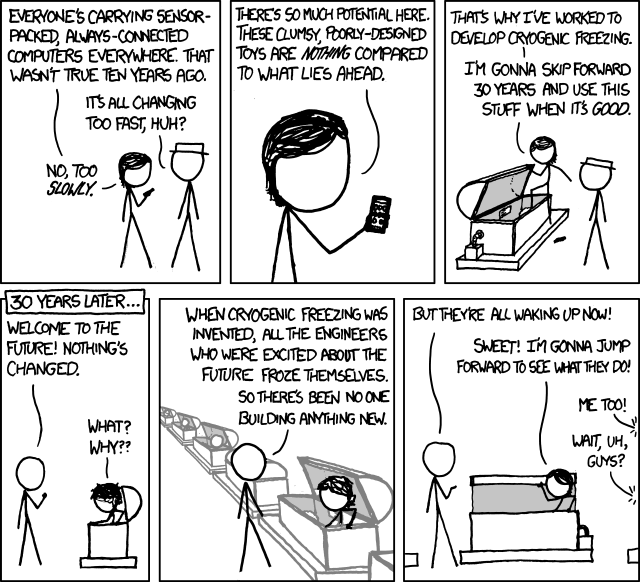
http://xkcd.com/989/
When we joined the Eurozone, I asked what Estonia's next great challenge was going to be. One suggestion was to join the Nordic Council, getting de-facto recognition of our status as a Nordic country (after which we would do absolutely everything in our power to make sure neither Latvia nor Lithuania could ever possibly join). But that was not significant enough; while it would be nice, it's simply not the kind of overarching goal and purpose that could unite the country in a singular pursuit.

These days I think a better challenge would be population growth. Twenty years ago, at the cusp of independence, Estonia's population was around 1.5 million; now it's 1.3 at a stretch. A lot of it is attributable to emigration in the 90s, in both easterly and westerly directions. Since that time successive governments have struggled with family-support legislation, tax breaks, baby benefits, etc. - and we've just about gotten to the point where the natural demographics are balanced, heading towards the positive: more babies will be born than people will die.

But following EU accession, global financial crisis, and the popping of the real-estate-fueled economic bubble, emigration is once again a big issue. A lot of capable and energetic talent is taking advantage of labor mobility laws, and going off abroad in search of fame, fortune, or just a good time.

Admittedly a lot of them will come back (and have). There is a sense of homeland that drives people back here, as evidenced both by the fairly high community of foreign expats married to Estonian women, and by my own experience during extended travels. I've almost literally been around the world, and while there are plenty of places where I could see myself spending a few years (Stockholm, Barcelona, NYC, Hong Kong, Singapore...), I know I'd always want to come back to Tartu.

The other issue is the difference between perception and reality. This is something I've also internalized while traveling: we might compare ourselves to countries with far greater GDP and income levels, but how different is the living standard, really? This summer, going across Europe by rail, I stopped overnight at a friend's house in southern Denmark. The guy is an IT professional, his wife is a specialist nurse. They live in a modest two-bedroom house, and their car is a ten-year-old diesel Ford Focus. Later on during that trip I ended up in Stuttgart, staying with a couple who had a really nice, large apartment; in their early-mid 30s, they didn't have children yet, and after traveling around the world themselves, they were very happy to meet other people by offering them a spare room via couchsurfing or airBnB. The guy was also an IT professional, this time for Mercedes (everyone in Stuttgart works for Mercedes, Porsche, or Bosch). He had a company car - but said that if he didn't, he wouldn't get a private one, because he and his wife didn't really need one and it is too expensive to run it in Germany. Months later, I was performing in Helsinki and talked to one of the biggest standup guys on that scene; he complained that while the average salary in Finland came out to something like 2700 euros (as opposed to 700 in Estonia), that really doesn't get you very far living in Helsinki. Indeed: a tuna sandwich in Rimi in downtown Tallinn or Tartu is 1.45. The same sandwich in Stockmann in Helsinki is over six euros. After Helsinki I went on my big trip for the year. In Northern California, I stayed with friends again - both professionals, established, in their 40s, childless for personal philosophic reasons. Their house is rented, and their one extravagance is a big powerful muscle car - a Dodge, far cheaper than an equivalent BMW that you'll see a lot of in Tallinn. Their previous car, the first one that either of them had purchased new, was a cheap basic Toyota. In Vancouver, I met up with a friend who drove a Neon, the Lada of North America.

All of these people are comfortably middle-class. The ones in Denmark are probably the closest to the median living standard for their country. The ones in California had the fanciest toy - but the biggest vulnerability to medical bills and, had they chosen to have children, the highest expenses for education.

So wherever you are in the Western world - of which Estonia is now firmly a part - you will end up with a roughly similar living standard for a given level of skill, ability and motivation. People who move out of Estonia hoping to significantly improve their circumstances through the sheer fact of living in a country with a higher GDP often find that this is not a magical solution. (People who intend to only work long enough to qualify for unemployment benefits and happily spend the rest of their lives eating instant noodles, sitting in a subsidized apartment and watching reality television, deserve as little sympathy and consideration as the societies that fail to prevent it.)

I tested this idea recently when an acquaintance mentioned the dire state of the Estonian medical system. She is a doctor who recently finished her training and went off to work in provincial Finland. This is a common enough occurrence: the University of Tartu's medical school is valued highly enough by our northern neighbors that a lot of their young people actually come here to study - it's cheaper and the entrance competition is easier. The doctor in question was concerned about the future of Estonia's healthcare as a whole: by her reckoning, at least 80% of medical students were learning Finnish, and very nearly all of them intended to take their skills elsewhere after graduation. (Norway is another country with a seemingly endless demand for medical professionals, and also one where the apparent living standard is not as high as you'd expect.)

My question to my acquaintance was this: what would have to happen, in a practical sense, for her to have decided to stay in Estonia? Or to now decide to come back, in light of her experience working up near the Arctic Circle?

The answer was not a higher salary, or access to new equipment, or better working conditions, or challenging cases to stimulate the imagination, learn new techniques and advance a career. It wasn't any of the completely valid and understandable gripes that I expected to hear when I asked the question. The answer was the way that the established classes in her chosen profession treated newbies - with lack of respect, not considering that they might also be smart, capable, trustworthy people who had something of value to contribute. The answer was attitude.

For her, and for a lot of other people I've talked to, the reason for emigration is the inability to handle Estonians' uncaring treatment of their fellow human beings. We are a country with universal free healthcare, nearly universal free higher education, easy access to tools of entrepreneurship, low levels of bureaucracy, trusted law enforcement that keeps the crime rate tolerable, and once you see the world for yourself, an objectively reasonable living standard. Hell, even our weather has been improving.

Estonia's biggest turnoff is that we just aren't nice to each other.

If we are to take up the new national challenge and grow our numbers, we have to do more than just make babies. We have to keep people in the country - or, perhaps even better, we have to make sure that people who've gone out into the world bring their valuable skills and experiences back here. We have to make Estonia a better place to be.

We are the ones who have to do it. Me and you. The only way to make Estonia a place where people are nice to each other is to start right now - start being nice to those around you, and keep doing it. Until they start doing it too, or until they die out, or until they go to Finland or the UK or Canada.

We won't begrudge anyone leaving to find the society in which they want to live. Meanwhile, you and I can stay behind, and improve this one.

Monday, September 19, 2011

Freedom and Suicides

One of the feeds in my podcast list is Freakonomics, and they had a recent special episode called The Suicide Paradox. It's a great show and a great series in general, but one of the side points they mentioned resonated with something else I had the chance to discuss and think about. Apparently, there is an empirically proven way to cover suicides in the press in such a way that prevents copycats, or even decreases the normal suicide level. Cover a high-profile event incorrectly, and you generate a spike in suicides.

This is a great example of the difference between freedom of the press and freedom of speech. I briefly went onto the Dan Carlin forums, where a question was posed: is Dan Carlin a member of the press? And in a wider sense, is every person with a means of broadcasting a member of the press? And therefore, should freedom of the press apply to bloggers, podcasters etc.? (The question about Carlin himself is a bit muddled because he used to be a mainstream radio show host before he started his own online podcast. Anyway, it's excellent if a bit US-centric and occasionally infuriating to a European, so I suggest you give it a listen. His other show, Hardcore History, has an even broader appeal and is also outstanding.)

The right of a blogger or podcaster to say whatever they will is covered by freedom of speech laws. Independent content creators like that do not need the extra protection that comes from press freedom laws. The very thing that makes them interesting, disruptive to the media landscape, and very important to the workings of society, also means that they should not be covered by press freedom laws. Because freedom of the press does not exist in isolation - it is inextricably linked to the responsibility of the press. Freedom of speech and freedom of the press overlap to a significant degree, but if you draw a diagram, you will see that they are shifted against each other. Journalists are protected from prosecution for certain things that members of the general public would get fined or thrown in jail for, and journalists are routinely given wider and deeper access to areas and information that is not disclosed to the public. But journalists are also subject to stricter standards on some issues. In some ways, they are more free than regular people; in other ways, they are less free.

The suicide coverage aspect is one good example of this. In a blog or podcast or YouTube clip or song or poem or novel, you can talk about suicides in any way you want. You are absolutely free to romanticize them, to make them feel heroic and wonderful and the only viable release from the unbearable tortures of the human condition. Nobody has the right to stop you, and in my personal opinion, rightly so. (I don't agree with every current legal practice on a moral level, even if I'm willing to abide by them. In this case, freedom of speech is both legislated and ethical.) However, if you are a journalist, and you cover a suicide in your publication in such a way that it leads to further suicides, then yes, you are responsible. You are professionally responsible on the legislative level, and you are personally responsible on the moral/ethical level.

An important clarification: you are responsible even if you were not aware the distinction exists. In this case - where there is clear evidence than press coverage makes a difference - you can't claim ignorance. If you are a member of the press, you do not have the excuse of not having studied this particular case in journalism school: you are expected to know better. The press is rightly held to a higher standard. This particular case does not quite generate criminal liability, but it's exactly why the press has ethical standards bodies. I'd say it's on about the same level as a doctor's liability for medical malpractice: you didn't directly cause someone to die, but it was in your power to prevent it. If you didn't make every effort to do so, you're not a killer, but neither are you allowed to carry that power any more.

A different aspect of expanded journalistic freedom is access to dangerous areas. This could be as drastic as embedded war reporters following soldiers into combat, and getting killed (the guy who made the highly praised documentary Restrepo was killed while covering the Libyan uprising). It could also be something much closer to home. Only a few months ago, right here in Estonia, a young girl died when a motorcycle crashed into her. She was a press photographer, covering a professional race. As a member of the press, she was allowed to stand close to the track, where regular people cannot go - even though that's where you get the best views. Her death is a tragedy, but she was allowed an expanded freedom because she took on an expanded responsibility. The rider whose bike it was that killed her was absolutely horrified, and stopped racing professionally, but he was not criminally liable for the killing - because the photographer knowingly put herself in harm's way. The photographer was the one with a greater standard of responsibility, not the competitor.

Bloggers, podcasters, independent broadcasters etc. will not and ought not receive protection under the freedom of the press if they're not willing to accept the responsibility of the press. Be it personal danger or the inability to say and write certain things, express certain opinions. You might think suicide is romantic, but if you work for Postimees, you're not allowed to say so. You have a responsibility to describe the mess and unpleasantness left behind, and emphasize the pointlessness of it, the fact that people won't suddenly be fascinated by the victim's deep and troubled personality - there will be nothing left except chunks of brain matter, or the contents the victim's bowels all over the floor.

There was a time when I was a journalist, a legitimate member of the press. I didn't go to journalism school - I applied, and got in, but decided that majoring in English would be easier - but I did get paid by mainstream newspapers, magazines and websites. I carried a press ID, and I was not afraid to use it. I stood in the press photographer area of a drag race event, where the flimsy wire fence would not have protected me if a thousand-horsepower Toyota Supra had suddenly blown a tire. I still feel the responsibility of a journalist when I'm commissioned by the mainstream media. Still, here, on AnTyx, I am not a journalist. I am a blogger. I do not have the expanded protection of the freedom of the press. But I do have the freedom to be an asshole to people.

Wednesday, May 04, 2011

Cheer With Them

From The New York Times, via.
So, Osama Bin Laden is dead. A few points to make.

1) May 2nd, 2011, will be remembered in history as the day the 2000s ended. It may be superficial and anthropocentric, but we do tend to think of near history in terms of decades, with each one having an overall mood. Decades don't end at the stroke of midnight on a year ending in zero, though. The 90s began with the fall of the Berlin Wall, and turned out to be a decade of triumph and growth. The 2000s, along with the century, began on 9/11. It was a decade of fear, uncertainty and doubt. The events of the last few months - the natural disasters, but also the end of the worst of the financial crisis and the Arab Spring - are momentous enough to be remembered as a particularly eventful season, but the bullet in the brain of Bin Laden is the bookend. I don't know what the next decade will be like, but my hope is that it will be the decade when we focus on practical solutions to immediate problems.

2) The question of whether or not Osama Bin Laden was actually killed then and there is irrelevant. If he'd died earlier and of natural causes - at least now there is public certainty that the ringleader is gone, and his followers have been denied a figurehead and a trickster legend. If he is still alive, hiding in a cave (or a Gitmo jail cell), and will never be heard from again - same difference for the rest of us. The murder of the concept of Osama Bin Laden is important to the world. The murder of the person is important to far fewer people.

3) Similarly, I can find no use in conspiracy theories that question whether Osama Bin Laden was in fact the person behind 9/11. The "inside job" people are obvious nuts; but I have seen some incredibly earnest and internally consistent arguments that this act of terror was not executed by this particular bunch of hateful individuals; it was, in fact, executed by a completely different bunch of hateful individuals who just happened to be standing next to them at the time.

4) For all that the US and its allies have behaved quite badly over the last decade, an important point has been made. Osama Bin Laden's stated political goal was to gain victory over the US by luring it into unwinnable wars and bankrupting it, like the USSR's Afghanistan debacle. On the face of it, he's gotten a long way towards succeeding: neither Afghanistan nor Iraq can be "won" in a satisfactory way, and the US has ramped up massive debts in the process. Yet the Great Satan has had the last laugh. At the end of the day, the message is: if you hurt us this badly, you will never be able to hide. You will never be able to get away with it. We will spend any amount of blood and treasure to hunt you down, and we will never stop. This is a vital point, a great discouragement to masterminds everywhere. In the same way that Israel has never stopped looking for and executing Nazi officials, the rest of the West will never stop looking for and executing terrorist leaders. The more inevitable we make a bullet to the brain and a watery grave (a more effective deterrent than a public trial and execution, despite the need for the supremacy of law in a free society), the longer and harder people will think before embarking on quests of destruction driven by personal hatred. By and large, the revolutions that succeed without a zealot at the top are the benign ones.

5) And finally. People have compared the cheering in the West at the news of Bin Laden's death to the cheering in the Middle East at the news of the 9/11 attacks. To some, both are equally unpleasant. But there is an enormous difference. Ten years ago, they cheered because they finally had a hope for war. Today, they cheer because they finally have a hope for peace.

So cheer with them.

-------
 EDIT: The Economist's Democracy in America correspondent echoes a similar sentiment:

Were the crowds outside of the White House celebrating bloodshed, or were they celebrating a perceived end to the bloodshed caused by Mr bin Laden (however wrong that assumption may be)? Were they rejoicing in a man's death, or rejoicing in the fact that this man can no longer cause death? [...] But I say the celebration didn't feel wrong because the one I observed did not have the jingoistic feel of so many post-9/11 gatherings in support of the troops, or the war, or the other war, or whatever. The revelers were not pumping themselves up for some future aggression. Sure, it was "America, fuck yeah!", but it was not "America, fuck you!" There was a satisfying sense of closure to an era of mass discomfort caused by our fears and our reaction to those fears.  

Monday, November 01, 2010

The Krugman Fallacy

This started as a Facebook comment, but got long enough to post as a separate article on here.

It's in reply to an editorial by Paul Krugman in the NY Times:

The key thing to bear in mind is that for the world as a whole, spending equals income. If one group of people — those with excessive debts — is forced to cut spending to pay down its debts, one of two things must happen: either someone else must spend more, or world income will fall.

Krugman's being disingenuous. He says that globally, spending equals income, and if you don't spend, others don't get income; and that people with high debt levels stop spending, which is a Bad Thing(tm).

However, where does the borrowed money come from? Either from "quantitative easing", which means it really does come from nowhere, or from capital markets, which is money that was saved and invested (i.e. not spent) by others.

Spending your way out of a recession is a short-term fix. Long-term, the world needs fiscal responsibility (not necessarily austerity, but responsibility), so that people do save money and put it into banks and treasury bills, so that the capital markets do have liquid cash to lend to businesses. 

(The severity of the financial crisis was not due to a lot of lost money - it was due to the financial institutions' unwillingness to extend credit to businesses, even ones in good fiscal shape. Global business does not work on cash up front, it works on promises backed by banks, and when banks stop supporting the promises, the entire machinery seizes up. That was the main problem - the billion-dollar losses only impacted the banks' employees and shareholders.)

In this crisis, quantitative easing kinda-sorta did the job it was supposed to, in the short term. But its usefulness is limited to emergency relief. If you keep pumping liquidity into capital markets via quantitative easing, you just get hyperinflation.

Krugman says that government should pump money into the economy, if the private sector is too scared to spend. That's fine, but where does the money come from? Either from quantitative easing, which has been stretched to the limits already (because that's what the US and the Eurozone have been doing), or from capital markets. Where do capital markets get the money? Either from quantitative easing, or from private sector savings.

Krugman's advice for the US is to spend on public works, driving up internal consumption. That's money that will never be compensated by liquidity gathered from outside the US economy. (Germany pumped money into its economy briefly, before switching to austerity; and it actually managed to stimulate industrial production and export growth. The tax revenue from that, the influx of liquid cash into the German economy, will probably outweigh the money spent on the stimulus.)

Krugman advocates debt relief for homeowners, saying that it will do less damage to the economy than mass foreclosures. He's technically right, but the argument doesn't reflect the big picture: without great damage, there will be no change in behavior, and without a change in behavior, the mistakes that led to the global crisis will simply be repeated.

You can blame the greedy and unethical investment bankers all you want - and don't get me wrong, they are complete bastards and deserve every last morsel of hatred they are getting - but all of their evil schemes would never have worked if it was not for the greed and short-sightedness of the everyday consumer, who wants a McMansion and a BMW and a 60-inch plasma TV, and ignores the fact that he can't actually afford any of it. Politicians won't say it, for obvious reasons, but the underlying cause of the financial crisis is not the greedy lenders - it's the greedy borrowers.

The failure of the financial oversight mechanisms to prevent the bubble is so apparent because the mechanisms themselves are so obviously necessary: nobody ever actually expected the lenders to not be greedy. It was always assumed that their greed will expand to fill any available volume. That greed can be checked by two means: government regulation, and the common sense of the borrowers. Yes, government regulation failed. That is no excuse for borrowers to escape responsibility for their own common sense.

Back to Krugman's arguments. For capital markets, and by extension the globalized economy as a whole, to be efficient and healthy in the long term, there needs to be a supply of genuine assets, genuine liquidity. Any kind of deficit spending must be covered by money borrowed from people (or companies) who saved it. People who have actual asset-equivalent that is not being used right now, and can be given to someone else to use for a time.

These savings only appear when the private sector spends less than it earns. It's a crucial and irreplaceable component of a healthy financial system. It's not about morality, mr. Krugman - it's about mechanics.

Tuesday, October 19, 2010

The Curious Correlation of FennoSwedes and EstoRussians

Here's a bit of a controversial thought for you. This gets really tangential, so try to keep up.

One uniquely Estonian experience is that of two native Russian speakers meeting outside Lasnamäe and talking to each other in Estonian. It's been twenty years; there's plenty of people in my generation who have grown up, gone to university, and gotten office jobs in Estonian-speaking teams. People who have no problem defaulting to Estonian.

But this is a very difficult language, and even if you're fluent, it's incredibly hard to lose an accent. I'm told that my accent in Estonian is not that of Russian, rather an odd and indistinguishable blend, but it's there; with anything more substantial than a conversation with a Selver cashier, people will realize I'm not a native speaker. There is also the issue of names. There is very little overlap between Estonian and Russian namespaces; with the exception of a few universal copouts, once you learn a person's name, you will know whether they are Estonian or Russian.

This is not a hard & fast rule. I've known people with Russian-sounding names who spoke no word of Russian and looked about as Nordic as you can get, and I've seen people with Estonian names born & raised in Ida-Virumaa, struggling to make themselves understood. I've also seen Russians who get married and take the Estonian spouse's last name. This can result in two kinds of hilarity: a girl with a Russian family name that stays in its masculine form, against the rules of Russian grammar, or a guy who took his wife's last name because he thought it might help him succeed in the workplace. (People who think this is a significant factor tend to underestimate the importance of actual competence, and as a result, fail.)

Anyway, as a native Russian speaker in Estonia you will occasionally find yourself in the very awkward position of speaking to somebody else in a language that is foreign to both of you, trying to figure out a non-offensive way to switch to the language that is far more comfortable. The difficulty is that if you just switch to Russian outright, you may end up being perceived as one of those assholes - the ones who go through life with a massive butthurt about linguistic discrimination. The people who actually have an opinion about the Language Inspectorate.

The interesting thing I've noticed is that these encounters have been getting a lot more frequent, and more importantly, people will often not bother switching to Russian any more. Yes, we both know that we can express ourselves more clearly in a different language, but the difference isn't that great any more, and there is a social penalty to switching away from Estonia. That social penalty is higher than the comfort.

You can call it conformism. But there's a more interesting parallel.

One of the enduring memes of Estonian minority politics is the status of the Swedish language in Finland. It's an official language, even though only about 6% of the population are native Swedish-speakers; all the street signs are in both Finnish and Swedish, and so is all the communication with state agencies. This is trotted out as an example to Estonia, proof that a nation state can be accommodating to a national minority, and that Estonians should try not to dislike the stubbornly Russian diaspora so much.

Previously, my reaction to this was that Sweden is not to Finland as Russia is to Estonia. Russia is to Finland as Russia is to Estonia; and Sweden is to Estonia as Sweden is to Finland. Sweden has conquered Finland at some point in the distant past, true; but this is now pure history, not the experiences of any living person. Hell, it would be quite difficult to find a Finn today who was alive before 1917 - the last time that Finland was not a sovereign nation! Finnish society, as it is today, is not threatened from within. It can accommodate the Swedish majority with little effort, and feel good about itself doing it. Just as the 9%-strong Russian community in pre-WWII Estonia enjoyed a broad cultural autonomy - broader than it's been since 1991, despite the fact that Päts's republic had every reason to expect trouble from eastwards. Travel today to the countryside around Haapsalu, and you will find road signs with village names in Swedish; the same will happen in Jõhvi fifty years from now, when Estonia is full of people for whom Russia is a land of St. Petersburg schoolteachers, coming over for a cheap coach tour of medieval castles, or filling up Old Town hotels in the mid-January off season because that's when they celebrate Christmas, the weirdos.

What I've discovered recently is that Finns actually don't like their Swedish population very much, and will not be particularly welcoming (even by Finnish standards) to a tourist attempting to engage them in the Swedish tongue. I've seen it happen, in the Academic Bookstore in downtown Helsinki, of all places: a younger saleswoman pretended to not know Swedish at all, but spoke it passably when chided by an older colleague.

Furthermore, the FennoSwedes - native Swedish speakers living in Finland - are quite actively disliked and distrusted by the general Finnish public. Not just because they speak a different language, but - and here is where I get to the point - because they tend to be the most wealthy, accomplished and happy demographic in Finland.

And the native Russian speakers who no longer care about switching away from Estonian? Maybe it's my own selection bias, but they tend to be yuppies. In the good, original sense: Young Urban Professionals, educated, with above-average incomes, and proud to be self-made. I'm not claiming causation; to say that just learning fluent Estonian is enough to succeed would miss the point completely - in fact, that's exactly what the discrimination paranoids would say. But perhaps there is a correlation. Perhaps the people who have it in them to become proficient in a foreign language or two, to improve their skills and work on their own careers, and to stop caring about nationalities, seeing the Estonian nation as a culture instead - perhaps they will evolve into the natural, meritocratic upper class of EstoRussians that will come to be despised by Pets from Väimela for a completely new set of reasons.

Personally, I can't wait.

Wednesday, March 10, 2010

The Extent of Freedom, Revisited

When I wrote this article, I was perfectly aware that it was a huge troll. I do stand by what I said, but I knew that for but a few exceptions (most of whom are zealots to a degree I find counter-productive, even if I'm on the same side of the fence as them), people would disagree strongly. The default mentality is that freedom of expression should be secured to the broadest extent possible. Even if I thought I found an exception with the minaret referendum - based on Switzerland's unique circumstance of demonstrable democracy - I can't argue against the rule itself.

Then recently, something triggered an odd thought.

What I was reading was a report on (in)tolerance in Estonia, prepared by ECRI - the European Commission against Racism and Intolerance. It's a consultative organ of the Council of Europe, itself a very suggestive and non-binding kind of organization. I have a natural distrust for entities of the caliber that the ECRI purports to be, but the report's findings were reported in the local press, so I went to look at the source.
Before going into my main point, let me just take a second to address the obvious issue with any report on social equality in Estonia: the ECRI report, while somewhat poking the government with a stick on integration, actually recommends outright that Russian schools be closed and all students made to do their studies in Estonian - something that the government has been doing very slowly over the last twenty years, and still isn't close to accomplishing, for fear of being labelled intolerant and discriminative. Which is, well, ironic.
The quote that tripped me up comes from page 8 of the ECRI report:

The provisions of the Criminal Code regarding racism are still very rarely implemented, primarily due to Article 151 which criminalises activities which publicly incite hatred, violence or discrimination on the basis of, among others, nationality, race, colour, language, origin or religion, only if they result in danger to the life, health or property of a person. Therefore, the ECRI considers that the Criminal Code does not, in fact, punish hate speech independently of specific consequences as recommended in its General Policy Recommendation No. 7 on national legislation to combat racism and racial discrimination.

Let that sink in for a second. The European Commission on Racism and Intolerance, part of the Council of Europe, advocates that hate speech be banned - criminalized - outright, even in circumstances where there is no demonstrable harm.

The obvious point is that this is not tantamount to banning minarets. Hate speech is not the same as religious self-expression. The point I tried to convey in the Switzerland article was that any broad-reaching humanitarian policy is only meant to be applied in situations where no clear picture can be established, and that if we encounter a uniquely unambiguous situation where the double majority of a community decides of its own free will to impose a restriction on itself, that decision must be respected - to undermine it would be to defy the very concepts of both liberty and common sense.

Let me be clear: Hate speech does not merit the same treatment.

Let me also be clear that I am not an unequivocal zealot of free speech. Obviously. But my writings here on AnTyx and elsewhere are personal; I am not affiliated with any political party, and while I do occasionally contribute to the media, I have not gotten paid for it in half a decade. My opinions are purely my own; I would like others to agree, but don't realistically expect it.

In other words, I am not the Council of Europe.

Is it really acceptable for a body that is, in its own words, "composed of independent and impartial members, who are appointed on the basis of their moral authority", to publically advocate and recommend that states adopt legislation that limits free speech, even when it causes no demonstrable harm? Yes, the state's obligation to protect its people from direct harm is unequivocal and trumps all other considerations. Yes, hate speech is probable cause for investigation, even if it's not an inevitable precursor of hate crime (one should never underestimate people's inclination to say extremely dumb shit out loud, and yes, I am well aware of the irony of this statement in blog).

Given all that, can a moral authority really recommend a limitation of free speech?

Thursday, March 04, 2010

*giggle*

Estonians are at their funniest when they take the piss out of themselves. In the words of DJBB, "no other people on this planet quite as proud of all its pain".

Anyway, this is almost as good as Wabariik.

Monday, November 30, 2009

Europe's Choice: Switzerland or Serbia?

Julien Frisch is very upset about the Swiss referendum banning minarets.

I disagree.

Julien says that a ban on minarets goes against the values of liberty, democracy and Europe. Now, I've said this before on AnTyx, but I'll say it again: as someone born in the Soviet Union, grown up in 90s Eastern Europe and now living in the EU, I think I can speak about democracy and freedom with some degree of authority. And there is an absolute, fundamental, irrefutable tenet of freedom:

Your freedom stops at the tip of my nose.

Switzerland did not ban Islam. Switzerland did not ban mosques. (And though I won't dwell on it, let's not forget that neither minarets nor even mosques are vital to the practice of Islam, that is a big part of why it's managed to thrive.) A minaret by its very intention is a thing that imposes itself on its surroundings. Not just architecturally, but socially: it exists as a platform for a cleric to call people to prayer. Five times a day, it saturates the neighborhood with sound that is unequivocally dogmatic. On that fact alone, a ban on minarets is entirely in line with European values of tolerance and coexistence. A secular state, particularly a European state, is obligated to protect its citizens from imposition of religion against their will.

I could leave it at that, but I won't. If there's a central message to everything I write on AnTyx, it is that you must know both cause and pretense; that you must not get bogged down in disingenuous arguments adopted by all sides because they are not willing to admit - often to themselves - what exactly it is that drives them.

I've done a Google search on Julien's blog for articles on Lithuania, and have found no mention of the country's deplorable anti-gay legislation. That's just one major issue I came up with, off the top of my head, simply because it's in my neighborhood. (Full disclosure: yes, Estonia isn't much better in this regard; I signed the recent petition in support of legal recognition of same-sex marriages, but I don't think it had any effect. But at least we don't have laws making it illegal to talk about LGBT in a positive light.) Another big issue that I can think of without really doing any research is the half of Cyprus that is currently occupied by Turkey. My point being: there are a lot of areas that threaten European values far more immediately than a non-EU country with a history of vehement direct democracy adopting a policy that can just as easily be implemented with a few administrative guidelines discreetly issued by whichever ministry oversees the urban planning commissions.

No, the reason why everyone suddenly cares about the Swiss referendum is because of the context, the discourse of Islam in Europe that is being actively promoted by the same caliber of activist that would torch cars and throw rocks at shop windows over a newspaper cartoon. Muslim punditry is, by far and away, the squeakiest wheel in Europe, and I dare Julien to prove me wrong.

Here is the question that critics of the Swiss ban have to ask themselves: Would you want these guys in your back yard?

European constitutions include, and European values are generally thought to contain, the protection of minorities against discrimination. I am continually astounded by how this is tragically misunderstood (and occasionally, criminally misconstrued). Democracy does not serve the interest of every citizen unequivocally. Democracy is the art of resolving conflicting interests, and it very rarely manages this to the satisfaction of all parties.

When the interest of the minority is so fundamentally at odds with the interest of the majority, the minority will simply have to be disappointed. (And when the interest of the minority is literally shouting religious propaganda from the rooftops, the minority really ought not be so surprised.)

And what is the alternative, exactly? When the double majority of the population is against something, enough to go and vote, then is it really the best course of action to condemn the un-European, discriminating bastards? Is it really so in line with the values of 21st century European civilization to force people to subdue their dislike of an ideology imposed by an aggressive minority? Do we take a nation where every adult male is legally required to own an assault rifle, and force them to live alongside the Muslims they want nothing to do with?

Because that happened, right here in Europe, less than two decades ago - and we've still got a bunch of judges in Strasbourg trying to figure out what happened.

Tuesday, September 29, 2009

The Reverse Nimby

I was looking through a bit of junk mail the other day, and saw a piece of really good translation in the Maxima supermarket chain's circular. Accurate, idiomatic, native - something this type of publication never seems to boast. For a while, I thought I might actually be starting to get my faith in humanity back. Obviously that didn't last.

Someone commented on a recent post that I am at my blogging best when I'm angry. Well, buckle up, cause you're in for a treat.

I first heard about the arrest of Roman Polanski in Switzerland from the Keith and the Girl podcast. I didn't pay too much attention to it, although I was a bit surprised at the fact that the French Foreign and Culture Ministers saw fit to publicly decry the US-requested arrest, and that representatives of the Swiss film community in effect said they were ashamed of the behaviour of their government. As the story made its way around the news sites and opinions started to come in, I became ever more astounded.

You can get the details elsewhere, but briefly, the facts of the case are these: in 1977, Roman Polansky, then in his mid-40s, was doing a photoshoot of a 13-year-old girl for a magazine. He gave her alcohol and drugs, and raped her. He was arrested, and pleaded guilty. After the conviction, but before the sentencing hearing, he left the US and went to France, which would not extradite him.

Now, a bunch of filmmakers have signed a petition against his extradition. And their argument is that he should not made to serve his sentence, because... he's such a great filmmaker.

Now, we already knew Woody Allen was a pervert. But other people are defending Polansky as well. Including people I know; people for whom I had a lot more respect before today.

It is a subset of a phenomenon I've seen before, the reverse of the Not In My Back Yard syndrome. Let me give you an example. A few years ago I was hanging out at the local Honda forum, and there was a thread about a particularly bad car crash. The party at fault had been pretty clear from the news reports, a forum member who had been driving extremely stupidly. The posters were all saying how much of an idiot he was... until one of them got offended, saying he was the driver's close friend. And to my utter dismay, the others apologized.

I've seen the same behaviour in other places, too - while growing up in Lasnamäe. No matter how evil someone had been, it was unacceptable to say anything to the effect of "he got what he deserved" or "I hope they put him in jail" in the presence of someone who'd been close friends with the bastard. You don't talk shit about my friend. The classic NIMBY is the desire for something particular to happen, but somewhere else, not in the vicinity of the subject himself, where it would have a chance of inconveniencing him. And the reverse NIMBY is the sort of mentality where justice and morals suddenly become relative, and mercy or consideration needs to be applied exceptionally, simply because the accused is someone you like.

Or someone whose movies you like.

Yes, Polansky does not appear to be an actual pedophile (there was no report of sexual abuse on his behalf before the incident or since). And yes, his wife was murdered by a serial killer while pregnant with their baby. And yes, the girl in question was someone who'd been in the adult world at the time, and was probably already sexually active, and her mother was a malevolent stage parent type who put her in harm's way. And yes, Polansky fled the country after he'd learned that he would probably be going to jail, instead of the psychiatric treatment and probation he expected to get. And yes, he'd been an Auschwitz prisoner. And yes, he made some great films.

But this was not statutory rape; this was not overreaction by the parents of an early-bloomer sixteen-year-old who was fooling around with her nineteen-year-old steady boyfriend. This was a 44-year-old man drugging a 13-year-old girl and violently raping her while she was begging him to stop. And if you can, in your heart, find any crumb of justification or excuse for Roman Polansky's actions, then you fail as a human being.

Roman Polansky must be extradited to the US, sentenced in court, and forced to serve a real jail sentence, and to suffer through whatever happens in jail to men who rape thirteen-year-olds. And if he dies in jail, I will not shed a tear. Because maybe all that will mean that some years from now, the threat and inevitability of punishment, even for someone with money, connections and public admiration, will serve to prevent another monstrous lapse of judgement, and another little girl's life will not be shattered.

Wednesday, May 06, 2009

Self-Made?

From a forum discussion... I reaffirmed my long-held belief that while there are aspects of a society that must be managed centrally and provided universally - such as healthcare, education etc. - the state's involvement should be limited to safety nets, ensuring minimum sustenance, but certainly not a comfortable living standard. Society is not obligated to support those who choose not to contribute, and highly developed welfare states do tend to produce that type of mentality, at least in some parts of the population.

The inevitable and, I'll admit, reasonable response to that was, Hardly surprising that an economically self sufficient 20-something with a high disposable income thinks that, is it?

Uh-huh, but I grew up as the child of a newspaper editor in a postsoviet economy. I'm not a trustafarian, so I get to say things like that.

Wow, you really don't have any idea how privileged you are, do you? You actually earned everything you have on your own accord?

I was lucky enough to be born in a country that became part of the Western world within my lifetime. Other than that - my education was paid for by the state (which is why I consistently say that education should be state-sponsored), and my healthcare costs were covered by the state as well (and I absolutely believe that universal healthcare is a non-negotiable human right).

My parents supported me in university, but didn't completely pay my way - I worked starting from the second semester until I graduated. I have never claimed any sort of unemployment benefit from the state. I got a state-sponsored cheap student loan, which is a system that I like and recommend, but it wasn't vital. I got my job by putting up a CV on a website, it had nothing to do with family connections or university old-boy networking (but, I suppose, everything to do with living in a country whose government found a way to attract massive amounts of foreign direct investment). My apartment was bought using inheritance as a down payment, but I'm covering the mortgage.

So - a question to both regular readers and people who know me in real life - exactly how hypocritical am I?

Saturday, January 24, 2009

Stop that. Right now.

Estonia is undoubtedly well served by having a voice as prominent as Edward Lucas speaking for us, but that doesn't mean the Economist's Eastern European correspondent is infallible, or insightful without exception. I may be a blogger, but the one thing I have always tried to avoid being is a pundit; a professional voice representing a particular set of beliefs or causes. The problem with pundits is that they are of very limited value to the everyday functioning of a society. They tend to manhandle any event or factor into their unified theory of reality, and that makes their conclusions and their advice flawed. Worse still, their neverending search for controversy and hardship can have a very negative effect on the general mindset. Master Lucas is entirely guilty of this, even if he is our bastard.

Submitted as evidence, his review of Detsembrikuumus. Nevermind his odd misreading of the plot (he writes that "only quick thinking and bravery by the protagonist (...) save the six-year-old Estonian republic from disaster", whereas the protagonist is in no way the heroic figure, nor all that central to the defeat of the coup). Nor will I dwell for long on the notion that "as the events of April 2007 showed, a cyber-attack can have roughly the same effect [as capturing a country's telegraph and post office in the 20s] without firing a shot", which shows a misunderstanding of the attack's nature that is shameful for anyone undertaking to draw such wide-ranging conclusions so publically.

I take far more offense to the assertion that "economic hardship has discredited the idea of independence in the eyes of many". Lucas admits elsewhere in the article that the 1924 attempt was executed (if not planned) by "idealists hoping to build a workers’ paradise" who are not to be found these days. So why does he, or anyone, seriously think that the economic crisis will be a test of Estonia's national spirit? We may become disillusioned with Europe - although on any significant scale, that's highly unlikely - but why would we become disillusioned with our country, a free and democratic state? Latvians and Lithuanians may throw rocks at their parliament buildings, but the petitions to foreign powers are still no more than a postmodernist comment (and besides, Estonia already got the principal benefits of such a union by placing the responsibility on the Swedish taxpayer to bail out our banking system).

Yes, we may be disgusted by our politicians, but that's what elections are for. I am disappointed that master Lucas has fallen victim to the fallacy that a government is tantamount to the state. The Republic of Estonia is a country where the ultimate power rests with its people. And as a people, we may be malcontent and reluctant to celebrate - or even recognize - our achievements. But we can do that, because in the heart of an Estonian lies the unshakeable belief that this is our land, and it is preposterous to even suggest that independence relies on prosperity, and that economic hardship might somehow challenge it.

Estonia has been frequently conquered, but it has never been crushed. Edward Lucas, please stop filling the minds of Economist readers (and Estonian emo kids) with this nonsense. Just stop.

Sunday, January 11, 2009

Oh, I suppose I need to talk about it.

So the Estonian courts have found Klenski, Linter, Reva and Sirõk not guilty of organizing the April riots.

Good riddance.

A lot of public figures, as well as pro-Estonian commenters, have called it a travesty and voiced their disappointment quite loudly. It was, they said, necessary to punish these four, to send a message that this kind of activity would not be tolerated.

In truth, it will be, and the country will be all the healthier for it. Those responsible for the damage and destruction - the local equivalent of white trash - have long since gotten their convictions and minor sentences. Some of them, who imagined themselves political figureheads in the making, tried to appeal and go all the way to Brussels, where nobody cared to listen to them. Which is as it ought to be.

As for these four, they are only of any interest to anyone as martyrs. There is nothing we (and I mean we as a society) could have done to destroy and humiliate them more than to provide a well-reasoned and impartial judiciary ruling of their utter irrelevance. They were on trial for organizing the most politically significant action to ever be carried out by Estonia's Russian community, or indeed by any opposition fraction whatsoever. And the court found them not credibly competent enough to have pulled it off.

We can afford to be magnanimous. We have nothing to gain from putting these men in jail. But we have certainly gained a lot from releasing them.

I do not make a habit of feeding the trolls outside a controlled environment, but observing them in the wild produces valuable insight. The court ruling produced a stunned reaction in the most hysterical corners of the Russian Internet. Oh, they still played their roles, but even those who kept regurgitating accusations of fascism on autopilot could not help but remark that such insolence against authority would never be so tolerated in the Motherland. The cognitive dissonance incurred by witnessing an application of impartial justice in what they still consider part of their mindscape was much-needed, though rare.

Of course, for the desired effect to be attained, all parties involved had to stick to their script. The fury and indignation of the coalition ensured that the court's ruling carried the necessary force. Still, I wish our politicians spent more time thinking about what they say.

Thursday, December 11, 2008

Direct democracy FTW?

The Estonian parliament has passed a bill that makes it possible for people to vote using their mobile phones. The law, which comes into force in 2011, equates national ID cards with secure, certified SIM cards.

The reason that online voting hasn't been very popular yet is that ID cards need several things to be used for the sort of authentication that the government IT network needs. You need a physical reader - which are cheap and available in any electronics store, as well as built into some new laptops - and you need certificates, which can be obtained online through a fairly quick and simple procedure. But the biggest problem is that you need to have your set of PIN numbers for the ID card. There's one short number for authentication, and a longer one used to sign documents digitally. You get these numbers in an envelope along with your ID card, just like you get your bank PIN.

The difference is that you use your bank card all the time, and with Chip&PIN authentication, you type in the number all the time, whether at a cash machine or in a shop. The ID card's PIN you don't use every day. In fact the only time you'll have to enter it, is when you are confirming your identity online. With the exception of people exchanging important, signed documents, and people regularly transferring large amounts of money (you can't send online bank transfers over 5000 EEK - a little over 300 Euro - without secure authentication), you just don't need the ID card's PIN in everyday life.

And the upshot is, interestingly, the same as what I said about SMS spam: the inconvenience is easy to eliminate, but most people aren't bothered enough to eliminate it. (You can get new PINs at any bank branch; but how often do Estonians walk into a brick & mortar bank branch these days?)

Now, with Mobile ID, that could change. I don't use Mobile ID myself (I don't think Tele2 supports it yet), but if the PIN is the same as your phone, and you don't need a separate reader - if the authentication is done purely on the handset - then we can actually expect the vast majority of eligible voters to have the ability to cast their ballots early and often.

The important thing is that the cost of running a vote is decreased significantly. It would be technologically feasible to transfer more and more decisions to a referendum. Estonia would approach that theoretical ideal of government: the direct democracy, where decisions would be made not by representatives, but by citizens themselves.

Your question for today: would that be a Good Thing?

Thursday, November 27, 2008

New Heights in Social Awkwardness

The unwillingness of Estonians to make eye contact and generally acknowledge each other's existence in common everyday interactions is a matter of lore. But some bastions of humanity remain, in the form of supermarket sampler counters. You get a little plastic bowl of salad or a toothpick with a piece of meat or cheese on it, and the counter is staffed by people who restock the selection. These are generally sociable and extrovert people who will happily prattle at you, praising the merchandise, inviting you to come over and try, and then telling you where to find the stuff on the shelves if you decide you liked it.

Went into Selver today, and there was a sampler counter with a whole bunch of tiny salad bowls on it, but no attendants. The management had decided to spare people the discomfort of acknowledging a human being when they're getting their free stuff, so instead they put up a suggestion box and a stack of paper slips where you could write if you liked the new kind of salad or not.

Wow.

Monday, November 03, 2008

AddThis

| More