Friday, January 20, 2012
MEP vs ACTA
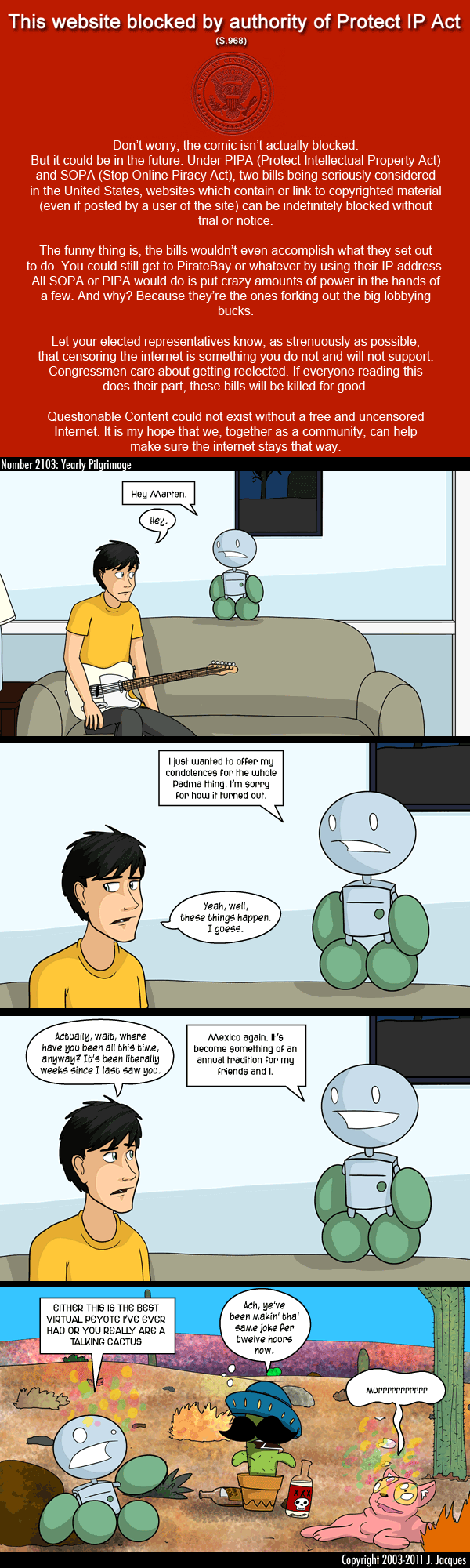
This Wednesday, Wikipedia and a bunch of other websites blacked out their content in protest to SOPA, a bill in the US Congress that would break the internet while not actually being effective at fighting piracy.
There is a version of this legislation that is immediately relevant to Europeans. It's called ACTA, and it's an international treaty that needs to be ratified by the Europarliament and individual EU member states before it goes into effect. The first step was approval by the European Commission, and that was done in a very underhanded and secretive way, to prevent the public from learning about it. Didn't work.
On the day of the SOPA blackout, I decided to be slightly more proactive, and do a little personal test of democracy. I went on Facebook and looked for the accounts of Estonia's Members of the European Parliament. Four of the six had accounts.* I sent a private message to three of them and posted on the wall of the fourth. (Facebook will only let you post on the wall of someone who already confirmed you as a friend, but you can message anyone directly. I happened to be Facebook-friends with Indrek Tarand already.) My question was simple: how do you intend to vote on ACTA?
That was two days ago, and impressively, two people have replied already. Ivari Padar said that he was not part of the committee that dealt directly with ACTA, but referred me to his parliamentary faction's position paper on it. It's a boring political answer and the paper doesn't actually say whether the Socialists & Democrats faction is for or against the treaty, but at least they're asking questions - and Padar scores points for promptly responding to a voter's inquiry.
The other response was from Tarand, who pointed me to his website. He'd published an opinion on ACTA as long ago as 2010, and while this is also a political text, it does make clear that Tarand's attitude to ACTA in its current form is negative. Hopefully he will vote against it if and when it comes up in the Europarliament's agenda.
Contact your MEPs and make sure the rest of them do as well.
---
*Tunne Kelam does have an account, actually, but I didn't find it at first - and it looks inactive (probably registered for him by a staffer to prevent squatting). Vilja Savisaar-Toomast has not replied yet, and neither has Kristiina Ojuland. Siiri Oviir does not have a personal account.
---
PS: This is the 600th post on antyx.net. Awesome.
Monday, December 12, 2011
No, You
![]() |
| http://xkcd.com/989/ |
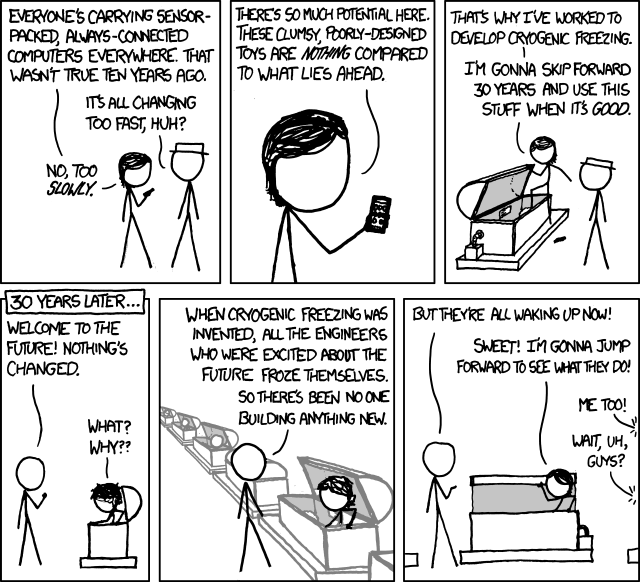
These days I think a better challenge would be population growth. Twenty years ago, at the cusp of independence, Estonia's population was around 1.5 million; now it's 1.3 at a stretch. A lot of it is attributable to emigration in the 90s, in both easterly and westerly directions. Since that time successive governments have struggled with family-support legislation, tax breaks, baby benefits, etc. - and we've just about gotten to the point where the natural demographics are balanced, heading towards the positive: more babies will be born than people will die.
But following EU accession, global financial crisis, and the popping of the real-estate-fueled economic bubble, emigration is once again a big issue. A lot of capable and energetic talent is taking advantage of labor mobility laws, and going off abroad in search of fame, fortune, or just a good time.
Admittedly a lot of them will come back (and have). There is a sense of homeland that drives people back here, as evidenced both by the fairly high community of foreign expats married to Estonian women, and by my own experience during extended travels. I've almost literally been around the world, and while there are plenty of places where I could see myself spending a few years (Stockholm, Barcelona, NYC, Hong Kong, Singapore...), I know I'd always want to come back to Tartu.
The other issue is the difference between perception and reality. This is something I've also internalized while traveling: we might compare ourselves to countries with far greater GDP and income levels, but how different is the living standard, really? This summer, going across Europe by rail, I stopped overnight at a friend's house in southern Denmark. The guy is an IT professional, his wife is a specialist nurse. They live in a modest two-bedroom house, and their car is a ten-year-old diesel Ford Focus. Later on during that trip I ended up in Stuttgart, staying with a couple who had a really nice, large apartment; in their early-mid 30s, they didn't have children yet, and after traveling around the world themselves, they were very happy to meet other people by offering them a spare room via couchsurfing or airBnB. The guy was also an IT professional, this time for Mercedes (everyone in Stuttgart works for Mercedes, Porsche, or Bosch). He had a company car - but said that if he didn't, he wouldn't get a private one, because he and his wife didn't really need one and it is too expensive to run it in Germany. Months later, I was performing in Helsinki and talked to one of the biggest standup guys on that scene; he complained that while the average salary in Finland came out to something like 2700 euros (as opposed to 700 in Estonia), that really doesn't get you very far living in Helsinki. Indeed: a tuna sandwich in Rimi in downtown Tallinn or Tartu is 1.45. The same sandwich in Stockmann in Helsinki is over six euros. After Helsinki I went on my big trip for the year. In Northern California, I stayed with friends again - both professionals, established, in their 40s, childless for personal philosophic reasons. Their house is rented, and their one extravagance is a big powerful muscle car - a Dodge, far cheaper than an equivalent BMW that you'll see a lot of in Tallinn. Their previous car, the first one that either of them had purchased new, was a cheap basic Toyota. In Vancouver, I met up with a friend who drove a Neon, the Lada of North America.
All of these people are comfortably middle-class. The ones in Denmark are probably the closest to the median living standard for their country. The ones in California had the fanciest toy - but the biggest vulnerability to medical bills and, had they chosen to have children, the highest expenses for education.
So wherever you are in the Western world - of which Estonia is now firmly a part - you will end up with a roughly similar living standard for a given level of skill, ability and motivation. People who move out of Estonia hoping to significantly improve their circumstances through the sheer fact of living in a country with a higher GDP often find that this is not a magical solution. (People who intend to only work long enough to qualify for unemployment benefits and happily spend the rest of their lives eating instant noodles, sitting in a subsidized apartment and watching reality television, deserve as little sympathy and consideration as the societies that fail to prevent it.)
I tested this idea recently when an acquaintance mentioned the dire state of the Estonian medical system. She is a doctor who recently finished her training and went off to work in provincial Finland. This is a common enough occurrence: the University of Tartu's medical school is valued highly enough by our northern neighbors that a lot of their young people actually come here to study - it's cheaper and the entrance competition is easier. The doctor in question was concerned about the future of Estonia's healthcare as a whole: by her reckoning, at least 80% of medical students were learning Finnish, and very nearly all of them intended to take their skills elsewhere after graduation. (Norway is another country with a seemingly endless demand for medical professionals, and also one where the apparent living standard is not as high as you'd expect.)
My question to my acquaintance was this: what would have to happen, in a practical sense, for her to have decided to stay in Estonia? Or to now decide to come back, in light of her experience working up near the Arctic Circle?
The answer was not a higher salary, or access to new equipment, or better working conditions, or challenging cases to stimulate the imagination, learn new techniques and advance a career. It wasn't any of the completely valid and understandable gripes that I expected to hear when I asked the question. The answer was the way that the established classes in her chosen profession treated newbies - with lack of respect, not considering that they might also be smart, capable, trustworthy people who had something of value to contribute. The answer was attitude.
For her, and for a lot of other people I've talked to, the reason for emigration is the inability to handle Estonians' uncaring treatment of their fellow human beings. We are a country with universal free healthcare, nearly universal free higher education, easy access to tools of entrepreneurship, low levels of bureaucracy, trusted law enforcement that keeps the crime rate tolerable, and once you see the world for yourself, an objectively reasonable living standard. Hell, even our weather has been improving.
Estonia's biggest turnoff is that we just aren't nice to each other.
If we are to take up the new national challenge and grow our numbers, we have to do more than just make babies. We have to keep people in the country - or, perhaps even better, we have to make sure that people who've gone out into the world bring their valuable skills and experiences back here. We have to make Estonia a better place to be.
We are the ones who have to do it. Me and you. The only way to make Estonia a place where people are nice to each other is to start right now - start being nice to those around you, and keep doing it. Until they start doing it too, or until they die out, or until they go to Finland or the UK or Canada.
We won't begrudge anyone leaving to find the society in which they want to live. Meanwhile, you and I can stay behind, and improve this one.
Friday, December 09, 2011
Thursday, December 01, 2011
Dokumenteerija
Here's a video of a lecture I gave to first-year IT students at the University of Tartu, on the job of a technical writer. It's in Estonian, and it's short; one of a technical writer's core virtues is to talk as little as possible while still getting your point across.
Monday, September 19, 2011
Freedom and Suicides
One of the feeds in my podcast list is Freakonomics, and they had a recent special episode called The Suicide Paradox. It's a great show and a great series in general, but one of the side points they mentioned resonated with something else I had the chance to discuss and think about. Apparently, there is an empirically proven way to cover suicides in the press in such a way that prevents copycats, or even decreases the normal suicide level. Cover a high-profile event incorrectly, and you generate a spike in suicides.
This is a great example of the difference between freedom of the press and freedom of speech. I briefly went onto the Dan Carlin forums, where a question was posed: is Dan Carlin a member of the press? And in a wider sense, is every person with a means of broadcasting a member of the press? And therefore, should freedom of the press apply to bloggers, podcasters etc.? (The question about Carlin himself is a bit muddled because he used to be a mainstream radio show host before he started his own online podcast. Anyway, it's excellent if a bit US-centric and occasionally infuriating to a European, so I suggest you give it a listen. His other show, Hardcore History, has an even broader appeal and is also outstanding.)
The right of a blogger or podcaster to say whatever they will is covered by freedom of speech laws. Independent content creators like that do not need the extra protection that comes from press freedom laws. The very thing that makes them interesting, disruptive to the media landscape, and very important to the workings of society, also means that they should not be covered by press freedom laws. Because freedom of the press does not exist in isolation - it is inextricably linked to the responsibility of the press. Freedom of speech and freedom of the press overlap to a significant degree, but if you draw a diagram, you will see that they are shifted against each other. Journalists are protected from prosecution for certain things that members of the general public would get fined or thrown in jail for, and journalists are routinely given wider and deeper access to areas and information that is not disclosed to the public. But journalists are also subject to stricter standards on some issues. In some ways, they are more free than regular people; in other ways, they are less free.
The suicide coverage aspect is one good example of this. In a blog or podcast or YouTube clip or song or poem or novel, you can talk about suicides in any way you want. You are absolutely free to romanticize them, to make them feel heroic and wonderful and the only viable release from the unbearable tortures of the human condition. Nobody has the right to stop you, and in my personal opinion, rightly so. (I don't agree with every current legal practice on a moral level, even if I'm willing to abide by them. In this case, freedom of speech is both legislated and ethical.) However, if you are a journalist, and you cover a suicide in your publication in such a way that it leads to further suicides, then yes, you are responsible. You are professionally responsible on the legislative level, and you are personally responsible on the moral/ethical level.
An important clarification: you are responsible even if you were not aware the distinction exists. In this case - where there is clear evidence than press coverage makes a difference - you can't claim ignorance. If you are a member of the press, you do not have the excuse of not having studied this particular case in journalism school: you are expected to know better. The press is rightly held to a higher standard. This particular case does not quite generate criminal liability, but it's exactly why the press has ethical standards bodies. I'd say it's on about the same level as a doctor's liability for medical malpractice: you didn't directly cause someone to die, but it was in your power to prevent it. If you didn't make every effort to do so, you're not a killer, but neither are you allowed to carry that power any more.
A different aspect of expanded journalistic freedom is access to dangerous areas. This could be as drastic as embedded war reporters following soldiers into combat, and getting killed (the guy who made the highly praised documentary Restrepo was killed while covering the Libyan uprising). It could also be something much closer to home. Only a few months ago, right here in Estonia, a young girl died when a motorcycle crashed into her. She was a press photographer, covering a professional race. As a member of the press, she was allowed to stand close to the track, where regular people cannot go - even though that's where you get the best views. Her death is a tragedy, but she was allowed an expanded freedom because she took on an expanded responsibility. The rider whose bike it was that killed her was absolutely horrified, and stopped racing professionally, but he was not criminally liable for the killing - because the photographer knowingly put herself in harm's way. The photographer was the one with a greater standard of responsibility, not the competitor.
Bloggers, podcasters, independent broadcasters etc. will not and ought not receive protection under the freedom of the press if they're not willing to accept the responsibility of the press. Be it personal danger or the inability to say and write certain things, express certain opinions. You might think suicide is romantic, but if you work for Postimees, you're not allowed to say so. You have a responsibility to describe the mess and unpleasantness left behind, and emphasize the pointlessness of it, the fact that people won't suddenly be fascinated by the victim's deep and troubled personality - there will be nothing left except chunks of brain matter, or the contents the victim's bowels all over the floor.
There was a time when I was a journalist, a legitimate member of the press. I didn't go to journalism school - I applied, and got in, but decided that majoring in English would be easier - but I did get paid by mainstream newspapers, magazines and websites. I carried a press ID, and I was not afraid to use it. I stood in the press photographer area of a drag race event, where the flimsy wire fence would not have protected me if a thousand-horsepower Toyota Supra had suddenly blown a tire. I still feel the responsibility of a journalist when I'm commissioned by the mainstream media. Still, here, on AnTyx, I am not a journalist. I am a blogger. I do not have the expanded protection of the freedom of the press. But I do have the freedom to be an asshole to people.
This is a great example of the difference between freedom of the press and freedom of speech. I briefly went onto the Dan Carlin forums, where a question was posed: is Dan Carlin a member of the press? And in a wider sense, is every person with a means of broadcasting a member of the press? And therefore, should freedom of the press apply to bloggers, podcasters etc.? (The question about Carlin himself is a bit muddled because he used to be a mainstream radio show host before he started his own online podcast. Anyway, it's excellent if a bit US-centric and occasionally infuriating to a European, so I suggest you give it a listen. His other show, Hardcore History, has an even broader appeal and is also outstanding.)
The right of a blogger or podcaster to say whatever they will is covered by freedom of speech laws. Independent content creators like that do not need the extra protection that comes from press freedom laws. The very thing that makes them interesting, disruptive to the media landscape, and very important to the workings of society, also means that they should not be covered by press freedom laws. Because freedom of the press does not exist in isolation - it is inextricably linked to the responsibility of the press. Freedom of speech and freedom of the press overlap to a significant degree, but if you draw a diagram, you will see that they are shifted against each other. Journalists are protected from prosecution for certain things that members of the general public would get fined or thrown in jail for, and journalists are routinely given wider and deeper access to areas and information that is not disclosed to the public. But journalists are also subject to stricter standards on some issues. In some ways, they are more free than regular people; in other ways, they are less free.
The suicide coverage aspect is one good example of this. In a blog or podcast or YouTube clip or song or poem or novel, you can talk about suicides in any way you want. You are absolutely free to romanticize them, to make them feel heroic and wonderful and the only viable release from the unbearable tortures of the human condition. Nobody has the right to stop you, and in my personal opinion, rightly so. (I don't agree with every current legal practice on a moral level, even if I'm willing to abide by them. In this case, freedom of speech is both legislated and ethical.) However, if you are a journalist, and you cover a suicide in your publication in such a way that it leads to further suicides, then yes, you are responsible. You are professionally responsible on the legislative level, and you are personally responsible on the moral/ethical level.
An important clarification: you are responsible even if you were not aware the distinction exists. In this case - where there is clear evidence than press coverage makes a difference - you can't claim ignorance. If you are a member of the press, you do not have the excuse of not having studied this particular case in journalism school: you are expected to know better. The press is rightly held to a higher standard. This particular case does not quite generate criminal liability, but it's exactly why the press has ethical standards bodies. I'd say it's on about the same level as a doctor's liability for medical malpractice: you didn't directly cause someone to die, but it was in your power to prevent it. If you didn't make every effort to do so, you're not a killer, but neither are you allowed to carry that power any more.
A different aspect of expanded journalistic freedom is access to dangerous areas. This could be as drastic as embedded war reporters following soldiers into combat, and getting killed (the guy who made the highly praised documentary Restrepo was killed while covering the Libyan uprising). It could also be something much closer to home. Only a few months ago, right here in Estonia, a young girl died when a motorcycle crashed into her. She was a press photographer, covering a professional race. As a member of the press, she was allowed to stand close to the track, where regular people cannot go - even though that's where you get the best views. Her death is a tragedy, but she was allowed an expanded freedom because she took on an expanded responsibility. The rider whose bike it was that killed her was absolutely horrified, and stopped racing professionally, but he was not criminally liable for the killing - because the photographer knowingly put herself in harm's way. The photographer was the one with a greater standard of responsibility, not the competitor.
Bloggers, podcasters, independent broadcasters etc. will not and ought not receive protection under the freedom of the press if they're not willing to accept the responsibility of the press. Be it personal danger or the inability to say and write certain things, express certain opinions. You might think suicide is romantic, but if you work for Postimees, you're not allowed to say so. You have a responsibility to describe the mess and unpleasantness left behind, and emphasize the pointlessness of it, the fact that people won't suddenly be fascinated by the victim's deep and troubled personality - there will be nothing left except chunks of brain matter, or the contents the victim's bowels all over the floor.
There was a time when I was a journalist, a legitimate member of the press. I didn't go to journalism school - I applied, and got in, but decided that majoring in English would be easier - but I did get paid by mainstream newspapers, magazines and websites. I carried a press ID, and I was not afraid to use it. I stood in the press photographer area of a drag race event, where the flimsy wire fence would not have protected me if a thousand-horsepower Toyota Supra had suddenly blown a tire. I still feel the responsibility of a journalist when I'm commissioned by the mainstream media. Still, here, on AnTyx, I am not a journalist. I am a blogger. I do not have the expanded protection of the freedom of the press. But I do have the freedom to be an asshole to people.
Subscribe to:
Posts (Atom)


